

Watch the full conversation with Catherine Jacobson below.
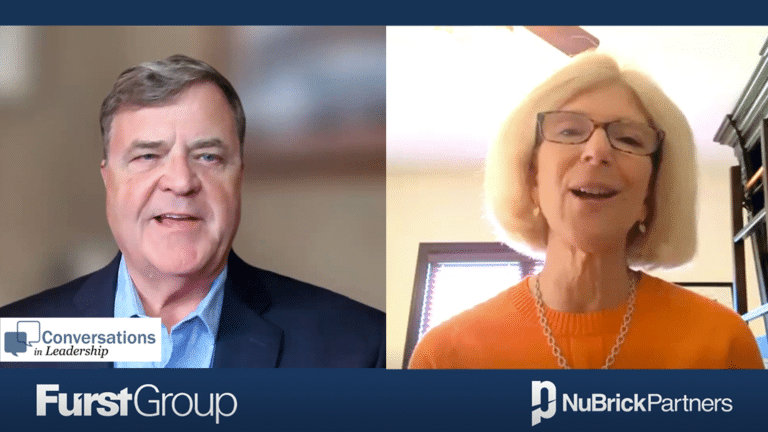
What allows a leader to succeed over the long term? For Catherine (Cathy) Jacobson, former CEO of Froedtert ThedaCare Health, the leaders best able to do that are humble ones, and humility is a trait she believes we don’t see as often as we should.
Cathy spoke with Bob Clarke, Chairman of Furst Group and NuBrick Partners, for a special edition of Conversations in Leadership featuring past recipients of the Gail L. Warden Leadership Excellence Award. Her reflections center on building the team around a leader, the discipline to say no sooner, the power of one standard held across an entire organization, and the hope that leaders leave their organizations better than they found them. Her perspective comes from healthcare, but the lessons apply to leaders and teams in any organization.
In 2024, Cathy received the Gail L. Warden Leadership Excellence Award from the National Center for Healthcare Leadership (NCHL), which recognized her in part for mentoring rising leaders.
Why Humble Leaders Build Teams Around Them
Bob asked Cathy what one trait she most hopes to see in emerging leaders. Her answer was about how a leader works with others. “I really think it comes down to humility, and believe it or not, we don’t see that, I think, as much as we should, because you can’t do leadership by yourself,” she said.
She went on to describe what humility looks like in practice. “You need to acknowledge that you always need to get better every day, that you can learn more every day. You don’t know everything. You don’t have all the right answers, and you need to put teams of people around you and really listen and really ask for their input, and then ultimately be able to bring them along.”
From our perspective at NuBrick Partners, the order in that description is worth noticing. Listening and asking for input come first, and that groundwork is what makes it possible to bring a team along when a decision is made.
Cathy connected humility directly to results that last. “I think really only the humble leaders that truly, truly believe they’re better with others around them are the best ones actually to be able to accomplish over the long term,” she said. “So I really look for humility and humble leadership as a big factor of success.”
Hear Catherine Jacobson explain why she sees humble leaders as the best able to accomplish over the long term.
Why Leaders Should Learn When to Say No
Asked for one piece of advice for emerging leaders, Cathy chose a lesson drawn from her own experience. “Saying no to something, I think, is actually harder than saying yes, in a lot of ways,” she said. It was advice, she admitted, that she wished she had followed “a couple of times.”
Looking back, she said her organization mostly got it right when it said no. The issue was how long it took to get there. “I think that we mostly got it right when we said no, but I would tell you that we probably spent too much time sometimes getting to that decision.”
That delay, she explained, affects more than the decision itself. “I think I learned myself as a leader that if you keep the conversation going for too long, you’re gonna disrupt maybe your team, maybe your organization if it’s a big enough deal.” Her guidance is to “learn when to say no and come to that decision much quicker.” As she put it, “If you think you’re gonna get there in three months anyway, just say no… and move away.”
Bob drew out the practical benefit. “Getting to a decision quickly saves everyone a lot of time and energy,” he said.
We see this as a useful test for leadership teams in any industry. A partnership, project, or plan that the team already doubts still draws on its attention for as long as the decision stays open. Naming the answer sooner frees the team to focus where it will count.
How One Shared Standard Can Shape an Entire Organization
When Bob asked about her greatest accomplishment, Cathy pointed to building Froedtert Health, now Froedtert ThedaCare Health. What she emphasized was the way the organization grew. “It’s not the size and the scale. It’s really, I think, the way we did it which makes me most proud.”
Cathy described taking “a culture of patient first, a culture of quality” and deciding “that quality was going to be the rock upon which we would build the health system.” The goal she described was bold, and it reached the whole system. “Not just at the flagship academic medical center, but every patient should have the best experience and have the best quality,” she said. “And we largely did it.” That focus on quality, she noted, “led to a partnership with another great quality organization, ThedaCare Health.”
From NuBrick’s perspective, the lesson for leaders outside healthcare is consistency. When one standard applies across an entire organization rather than only in its most visible part, every team works from the same reference point.
Hear Catherine Jacobson describe how one standard of quality shaped an entire health system.
Leaving an Organization Better Than You Found It
Cathy closed the conversation by looking back on 40 years in healthcare. “This is an amazing career that we’re blessed to be able to do,” she said. “To be able to take your education, your technical skills, whatever you bring to the table, whatever you’ve learned about leadership, and be able to apply that to make people’s lives better. I just really think in retrospect that’s a special gift…”
She also looked to what a career leaves behind. “Hopefully all of us had the opportunity to leave our organizations better than when we found them,” she said. “And hopefully the people coming up after me will do the same.”
For us at NuBrick Partners, that aspiration sits at the heart of leadership development. Leaving an organization better depends on more than one leader’s tenure. It depends on the people a leader develops and on teams that keep raising the standard after any one person moves on.
Hear Catherine Jacobson reflect on using everything a leader has learned to make people’s lives better.
Bold Leaders Who Don’t Stop Trying
Asked about her biggest hope for the future, Cathy was candid that healthcare still has “so much more work to do,” and that even within its constraints, “there are many things that we as leaders ourselves can do.” Her hope rests with the leaders who come next.
“My hope for the future is the next generation of leaders doesn’t stop trying and really is very bold, comes up with innovative, new things, adopts innovation, looks for partnerships, look for a collaboration…” she said.
Hear Catherine Jacobson share her hope for the next generation of leaders
What Leaders and Leadership Teams Can Take From Cathy’s Approach
In our view, the habits Cathy describes apply in any industry. Put teams around you, listen to them, and bring them along. Decide sooner when the answer is no. Hold one standard across the whole organization. And aim to leave the organization better than you found it.
Leadership teams looking to strengthen how they work together might start with three questions drawn from her experience. Does our team ask for input early, before decisions are made? Are we keeping a decision open longer than it deserves? And are we developing the leaders who will carry our standards forward?
At NuBrick Partners, we partner with leaders and leadership teams to build the trust, candor, and discipline that lasting results depend on. Learn more about NuBrick Partners.
Bob Clarke, Chairman of Furst Group and NuBrick Partners, in conversation with Catherine Jacobson, former CEO of Froedtert ThedaCare Health.
About
Catherine Jacobson: Catherine (Cathy) Jacobson is the former CEO of Froedtert ThedaCare Health, Inc., in Milwaukee. She joined Froedtert Health in 2010, became President in 2011, and became President and CEO in 2012. She led the organization through its January 2024 combination with ThedaCare before retiring as CEO of Froedtert ThedaCare Health in June 2024. Before Froedtert, she spent 22 years at Rush University Medical Center in Chicago, where her roles included Chief Financial Officer. She serves on the boards of Teladoc Health and Vizient, where she is a past board chair, and received the Gail L. Warden Leadership Excellence Award in 2024.
The Gail L. Warden Leadership Excellence Award: Presented by the National Center for Healthcare Leadership (NCHL), the award honors Gail L. Warden, NCHL’s founding chair and President Emeritus of Henry Ford Health. It celebrates individuals who have driven meaningful, enduring improvements in health and healthcare through visionary leadership and a strong commitment to the wellbeing of their communities.
Conversations in Leadership: Conversations in Leadership is our series featuring candid perspectives from healthcare leaders, hosted by Bob Clarke, Chairman of Furst Group and NuBrick Partners. In a special edition of the series, Bob, who serves on the NCHL Board of Directors, connects with past recipients of the Gail L. Warden Leadership Excellence Award to reflect on the decisions, challenges, and lessons that define great leadership.
